Commercial Flat Roof Replacement Bloomington MN
The Facility Manager’s Guide to CapEx, Codes, and Total Protection
When our Commercial Flat Roofing Specialists stand on a 50,000-square-foot commercial deck off the I-494 corridor in late February, looking out over the Bloomington skyline, two things are immediately obvious.
First, this city is the economic heavy-hitter of the South Metro. Between the high-turnover retail properties near Southtown, the multi-story corporate hubs in Normandale Lake Office Park, and the massive logistics facilities down in the Minnesota River valley, there are billions of dollars in active inventory sitting directly beneath our feet.
Second? A shocking number of these buildings are operating on borrowed time… In the commercial sector, a roof leak doesn’t just ruin some drywall; it halts a conveyor belt, destroys palletized stock, shuts down a surgical center, or triggers a tenant lawsuit. For over 30 years, our commercial division at Englund Roofing & Sheet Metal (License #RR780995) has worked alongside Bloomington property managers, REITs, and facility directors. We view commercial roofing through a very specific lens: we are not here to sell you a membrane; we are here to protect your net operating income.
The “Low Bid” Trap: Navigating Minnesota’s Updated Commercial Energy Codes
If you are a facility director putting a Bloomington re-roof out to bid this year, we need to give you a very blunt piece of advice: look at the insulation line item before you look at the bottom line.
Every summer, we get called to fix or take over a commercial project that was red-tagged and shut down by City of Bloomington building inspectors. Why? Because a contractor tried to win the job by quoting a 2018 insulation package in a 2024–2026 regulatory world. Under the updated Minnesota Commercial Energy Code (aligned with ASHRAE 90.1-2022), the goalposts have moved:
- The R-30 Continuous Mandate: For an above-deck commercial replacement in Hennepin County, the state strictly mandates a minimum thermal resistance of R-30. If a roofer quotes you a single layer of 3.5-inch Polyiso (roughly R-20), they are setting you up for a failed inspection.
- The R-10 “Radiator” Rule: This is the detail that catches out-of-state storm crews. Under Minnesota Rules 1323.0553, every single rooftop mechanical curb, skylight box, and HVAC sleeper must now be independently insulated to R-10. Think of an uninsulated raw steel HVAC curb like the handle of a cast-iron skillet left on a stove—it grabs the heat from your tenanted space below and radiates it straight into the freezing winter sky.
The Four Realities of a Bloomington Commercial Deck
A residential roof is an umbrella; a commercial roof is an active mechanical floor. It has to survive four extreme local stressors simultaneously:
- Dead-Weight March Snow: When a heavy, wet spring blizzard drops 18 inches of snow over the Minnesota River valley, a 40,000-square-foot flat warehouse deck is suddenly holding over 800,000 pounds of dead weight. Your underlying rigid insulation cannot compress, or you lose your rooftop slope instantly.
- 24/7 Mechanical Harmonic Stress: Go stand next to a commercial air handler on a hot Tuesday in July. Put your hand on the deck. You will feel a constant, low-frequency hum. That 24-hour micro-vibration works tirelessly to back out mechanical fasteners and fatigue standard glued seams.
- The 48-Hour Ponding Clock: When a July microburst drops three inches of rain on West Bloomington in forty minutes, your internal drain bowls have to swallow it. If a puddle sits on your membrane for more than 48 hours, the summer sun turns that standing water into a chemical magnifying glass, cooking the plasticizers right out of the sheet.
- The I-494 “Wind Peel”: Commercial buildings exposed along wide interstate corridors act like giant airplane wings. When 70-mph straight-line winds hit the side of your warehouse, the air is forced violently upward, creating massive negative suction right at your parapet walls. If your perimeter edge metal was crimped on by an amateur, the wind will grab it and unzip your roof in five seconds.
The Big Three: Choosing Your Best Flat Roofing Options | TPO, EPDM & PVC
We don’t push a proprietary brand just to hit a manufacturer quota. When we walk your roof, we look at what your building does. Do you exhaust kitchen grease? Do you have heavy foot traffic from HVAC techs? Do you pay the cooling bill, or does the tenant? We select from the three true heavyweights of single-ply roofing:
|
Membrane Type |
The Trade Nickname |
The Best Bloomington Application |
Real-World Lifespan |
|
The AC Slasher. Highly reflective white sheet with heat-welded seams. |
Sprawling logistics hubs and unshaded low-rise office parks. It bounces the sun back to space, keeping warehouse floors ten degrees cooler. |
20–30 Years |
|
|
The Minnesota Tank. Thick, dark, ultra-flexible synthetic rubber. |
Automated manufacturing plants. It absorbs winter sun to melt off dangerous ice loads and takes a beating from spring hail. |
25–35 Years |
|
|
The Grease Shield. Incredibly tough, chemical- and fire-resistant polymer. |
Fast-food clusters, Mall of America out-parcels, and industrial printing or chemical facilities. |
25–30 Years |
When you have to sit across from a property owner or an executive board and ask for a $150,000 CapEx sign-off, feelings don’t work. Hard data does.
Use our financial modeling tool below to test how upgrading your facility to the new R-30 code impacts your long-term utility overhead and payback schedule:
- Specialist’s Tip: Pushing your insulation spec just slightly past the code minimum to an R-35 configuration frequently triggers Tier-2 commercial Custom Efficiency Rebates from CenterPoint Energy and Xcel Energy—often covering the cost difference of the extra foam layer entirely.
- Our Zero-Downtime Commercial Playbook: Replacing a commercial roof while a business operates underneath it is an exercise in extreme logistics. You cannot have a 100-ton crane blocking a semi-truck from backing into Loading Dock 4.
We run a strict, synchronized five-step operational sequence:
Core Sampling & Ground Staging:The ‘No Guesswork’ phase.
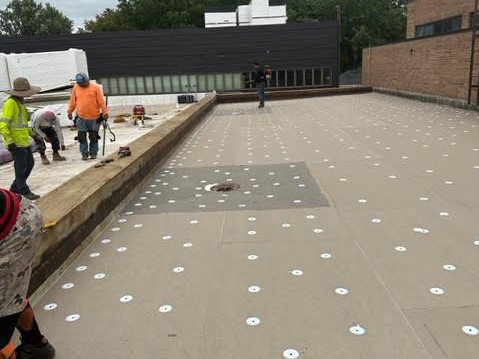
Before we ever order a roll of membrane, we pull physical core samples down to the flutes of your steel deck to check for trapped interstitial moisture. We then map out secure ground staging areas with your safety director to keep tenant parking and shipping bays clear.
Staggered Multi-Layer Polyiso:Killing the thermal breeze
We lay down your R-30 insulation matrix in multiple staggered layers. If you lay down one thick board, the microscopic gaps between the boards act like chimneys for your interior heat. Staggering the joints traps the air completely. We then map in custom-sloped foam “crickets” behind every HVAC unit so water can never get trapped behind the curbs.
High-Density Cover Board Fastening:The ‘Dropped Tool’ insurance.
We lock down a 1/2-inch high-compressive cover board over the foam. When a third-party HVAC technician drops a 20-pound pipe wrench off a ladder onto your roof next November, this board takes the dent so your waterproof membrane doesn’t take a puncture.
Robotic Hot-Air Seam Welding:Fusing the field.
We deploy our automatic hot-air welding crawlers across the TPO or PVC field seams. A human gets tired at 3:30 PM on a Friday; a Leister welding robot does not. It drives along the seam at an exact, calibrated speed and heat, fusing the two sheets into one continuous piece of plastic.
Curb Armor & Wind-Cleated Coping:Hand-crafting the danger zones.
Our veteran sheet metal mechanics hand-weld the tricky stuff: the pipe penetrations, the pitch pockets, and the interior drain sumps. We wrap the HVAC curbs in R-10 insulation and lock down custom-fabricated, heavy-gauge metal parapet copings hooked onto continuous cleat strips that defy straight-line winds.
Why South Metro Asset Managers Trust Englund
When you manage a commercial portfolio, your job is risk mitigation. You need a contractor who solves headaches, rather than creating them for your legal department.
- We Are A Known Quantity: We have been rooted in the Twin Cities commercial sector since 1994. We don’t change our LLC name every five years to outrun bad warranty claims.
- True NDL Warranties: Because of our master commercial status with manufacturers like GAF, we offer NDL (No Dollar Limit) warranties. This means that if a welded seam fails in year 18, the manufacturer pays the total cost of labor and materials to remediate it—even if inflation means it costs triple what you paid us to install it.
- We Respect Your Tenants: We coordinate the “deafening” work—like mechanical deck fastening or deck scraping—strictly during early morning windows or scheduled facility down-times.
- A Real Commercial Service Desk: When a frozen scupper backs up into an electrical room at 4:00 AM on a Sunday, your automated answering service won’t fix it. Our dedicated commercial emergency leak crews are dispatched directly via (651) 917-7663.
Let’s Get a Set of Eyes on Your Commercial Deck
You shouldn’t be making CapEx decisions based on a hunch or an old spreadsheet. Whether you need a non-destructive infrared moisture scan for an office complex off Normandale Boulevard or an aggressive, code-compliant TPO bid for an industrial facility along 24th Avenue, let’s talk.
Contact Englund Roofing & Sheet Metal Today to Schedule Your Commercial Site Audit & CapEx Proposal